Welcome to Joyful Toddlers!

This space is about increasing our enjoyment of the young children in our lives through concrete action and by adjusting the lens through which we view them. My work comes out of LifeWays, which is inspired by Waldorf education. I welcome your comments, and questions about increasing your enjoyment of the children in YOUR life.

JOYFUL TODDLERS HAS MOVED! CHECK OUT OUR NEW LOCATION http://joyfultoddlers.com/

Showing posts with label home. Show all posts

Monday, October 24, 2011

Toddler/Infant Sibling Interactions

My daughter is two and my son is almost one month old. My daughter is madly in love with her baby brother and wants to hold and carry him. I help her hold him while sitting down, but am having a tough time redirecting when she tries to pick him up or take him out of my arms and pulls on him. I find myself saying no while playing tug o war with my infant- not effective parenting :( Really, I'm looking for advice on those situations when the toddler puts herself or others in harm’s way. Another similar example is that when she plays with her friends, she will hug and not let go until the friend cries or falls over.

Dear Erin,
               It always feels like such a shame when we see a child go in with good intentions, only to have things end poorly.  I have had several children in my care whose instincts for affection seem to be to grab and not let go.  The good news is that their hearts are in the right place.  The bad news is that it’s a hard habit to break!  I’ll answer the sibling part of your comment today, and address the friend-hugging another day.

Toddler/Infant Sibling Interactions
               I’ve noticed that two-year-olds with infant siblings do best when they get lots of help with EVERY physical interaction, until they have strong habits in place.  The best way to establish these habits is to have very firm ‘rules’ about how it’s OK to touch the baby:  she can hold him sitting down while you help, or she can touch him with one finger.  I’m a huge fan of one-finger-touching for 1- and 2-year-olds.  It is useful for ANYTHING they might want to grab, that could be hurt or ruined:  flowers, computers, your earrings, your baby son.  So, first introduce these rules.  She already knows about you helping her hold him when she’s sitting down, so introduce the one-finger rule.  “You can touch your brother with your one finger.  This is how we do it.  That’s right!  You’re doing it too!  You can always touch him with your one finger.”  Then, for the next several weeks, EVERY time you see her going to touch him, jump to her side and help her touch him with her one finger.  Whenever she tries to touch in another way, lovingly show her how she CAN touch him.  (If she is able to kiss him without grabbing, kissing on the cheek or arm is OK too.  If she can’t resist grabbing when she kisses, teach her to blow kisses to him to show her love and affection.) After a few weeks of physically helping her touch with one finger every time, you will start to be able to remind her verbally from a little distance away.  Soon she’ll do it by herself, looking right at you.  “That’s right!  You know how to touch your little brother!”  Even once she does that, she may still need help when she’s tired or excited. 
She may also occasionally try to touch him in another way, looking over at you to see if it’s OK.  For now, go ahead and remind her how she CAN touch him—with one finger.  Once her habits of touching him really gently are firmly in place, you can start to expand from there.  Acknowledge that you’re changing the rules.  “Now that you know how to touch him so gently, you can touch him with your whole hand.  You can stroke his arm, like this.  Yes!”  Expand the acceptable ways of touching very slowly, and start helping her notice if he’s liking her touch or not liking her touch.  “Look, he’s pulling away.  He’s saying, ‘that’s too rough!’” or, “Even though you’re touching him gently, he’s saying ‘Not right now.’” And help her touch him in a way that he likes, or if he’s not liking anything, to pull away and blow him a kiss instead.
This technique is very energy-intensive for several weeks or even a few months.  But it’s totally worth it, because you’re laying the foundation for positive sibling interactions for the rest of their lives.  Siblings who notice what the other one wants (or doesn’t want), and respond respectfully to those cues, have positive relationships with one another.  This noticing and responding respectfully is the key to bypassing the bossy/bullying/playing-the-victim/picking-on-each-other-till-they-explode cycle that can mar many sibling relationships.  So start laying the groundwork now!

Joyful Toddlers has moved!  Check out our new location: http://joyfultoddlers.com/ 

Friday, May 27, 2011

Toys

People have asked me about toys for toddlers, my ‘must have’ list.  Mostly, I think that children do better with fewer toys than we would ever imagine.  If you want a more comprehensive list, look in Kim John Payne’s book “Simplicity Parenting.”  But here’s my list: 
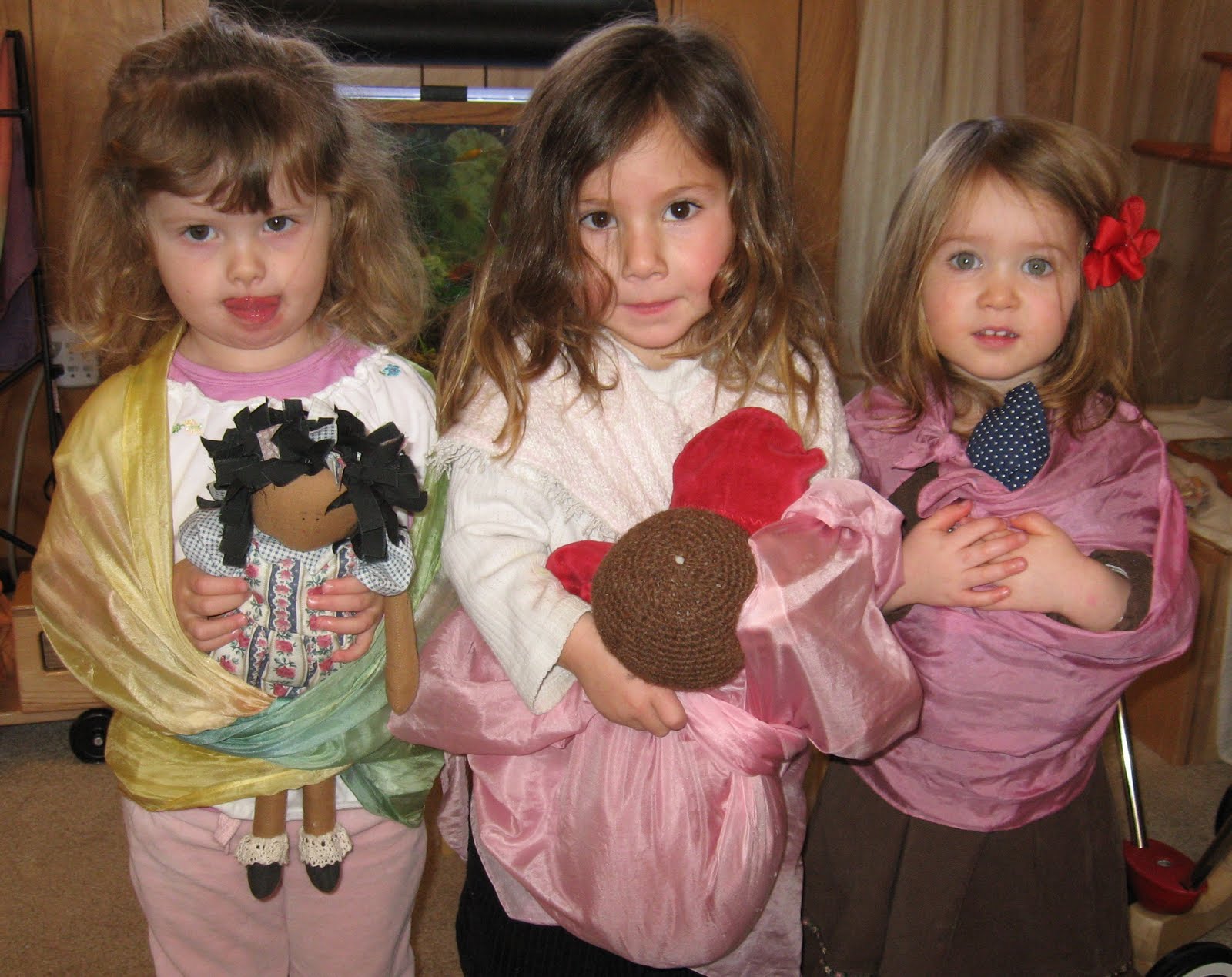
-First, colored silks.  These are so versatile and can be used for so many different things:  as a cape or skirt, as a baby blanket, as a sack for carrying things around…etc. etc.
-Next, a basket of soft balls of various sizes.  These balls are what are appropriate to throw inside, so whenever a child forgets and throws something else, you can remind her: “What can we throw inside?”  If she’s too little, you can answer for her: “Soft balls!  Where IS a soft ball?”  And she can run over to the ball basket. 
-Third, a play-kitchen.  The first step of imaginative play is largely imitative, and children will act out what they see around them in their play, as their way of processing experiences.  Since many of us spend lots of time in the kitchen, a play kitchen is paramount!  (warning:  I don’t love those vegetables that come apart into pieces with Velcro in between.  It seems cool in the ad that the kids can ‘cut’ them apart, but the reality is that they never go back together, at least with little one.) 
-Books.  Many Waldorf programs don’t have books, but I know that many children use books as a way to self-soothe, and when kids are tired it can be really nice to snuggle on the couch together and look at a book.  I don’t usually read the words; most of the time I talk about the pictures with them.
-Dolls.  Not too many, though; each doll should be really special and cared for.  I tend to think that three is a good number.
-Things for kids to push.  These could be wooden trucks or metal Tonka trucks outside, or a baby carriage, or a duck that flaps its feet as it walks.
-Paper and crayons to be brought out periodically.

Really, this is enough.  As kids get older, dress-up clothes start to become popular, but again, less is better.  When each toy is special and cared-for, and each thing has its own designated space, then toys are used more often, and more imaginatively.  I am a big believer in rotating toys, as children will approach things with new eyes when they've had time to grow a bit in between.  So whenever you notice your play-room or livingroom or a child's bedroom feeling cluttered, or cleaning up taking more energy than you wish, take several boxes out and fill one to give to Goodwill, and the other to put in the shed for a few months.

Joyful Toddlers has moved!  Check out our new location: http://joyfultoddlers.com/

Thursday, March 3, 2011

Practical Tips on "Life"

 So what can we do, as parents and caregivers, to ensure that these household tasks foster connection, foster competence, and foster the children's ability to contribute? What can we do to help tasks go smoothly, so that we don't feel frazzled as we try to incorporate children into the neverending tasks of housework? It turns out there are lots of things we can do:
  1. Slow Down! Take your time with each task. Make each task an activity that's worthwhile for its own sake, taking special care with the daily tasks. Approach each one with respect and enjoyment. When you rush, children tend to steer clear and try to stay out of your way, or they try to pull your attention away from your task and onto them, to get you to stop rushing. When you slow down and take your time, you have enough attention for the task and the child at the same time, and children will want to join in with you.
  2. Develop a rhythm. By rhythm, I mean to do things in the same way, at the same time, as often as you can. I fold laundry each day during free-play time. It gives me something to do so that I can be present and watch children play without being directly involved unless I'm needed. And I love to brush the children's hair after naptime. What a lovely way to bond with each child as we engage in bodily care.  Children are used to me doing these tasks at these times; it's an accepted part of our lives together.
    The other piece of rhythm is that when we do things the same way each time, children can learn that skill. Children learn through imitation. If you have any doubts on this score, read this article from Science Daily, titled “Humans Appear to Be Hardwired to Learn By 'Over-Imitation.'” What it shows is that children do things the way we do them. Even if we tell them to do it differently, they will still do things the way we do them. So think carefully about HOW you're doing things, the attitude that you bring to each activity. This attitude is picked up by the children as well.
  3. Use songs. Songs are a great way to connect with children, and they are also a great way to help kids track where in the process you are. I have a song for washing the table, for sweeping the floor, for folding the laundry. I also use songs for repetitive tasks like passing things out to each child, or if we're taking turns stirring the bowl, etc., each child gets to stir for the duration of a short song.  In addition, I'll also hum while I am doing a task by myself. I find that when I hum I slow down myself, and the children all around me settle down. I think when they hear me humming, they feel like I'm right there with them, even if I'm not looking at them or interacting with them. It allows my presence to fill the room and children can rest secure that I'm there with them and not distracted by other things.  You don't have to be a "good" singer for this to feel fulfilling for children.
  4. Set yourself up for success. By this I mean, figure out how kids can be involved, and be prepared. Most of the tasks I do while the children are playing, and children can join me or not, as they choose (although if a child is having trouble being gentle with others, we'll find some good work for those hands to do and they stay by my side until they are ready to try being gentle again). But when I go to wash a table, I'll bring two extra washcloths with me, and as I start to sing my table-washing song, children might come over and ask to help, and I have a cloth right there. Other tasks I know will be very popular, such as baking, so I gather all of the materials together before we get started, so that things can go smoothly. Another thing that helps things go smoothly, especially if you're alone, is to have an easy exit. If you and another child are washing dishes together but a tussle breaks out in the play-room, I'll lift the child down from the sink, pull the chair away, and ask them to sit on the chair until I get back.
  5. Appreciate effort over results. Young children are process-oriented, not results-oriented. While washing dishes, a two-and-a-half year old will often happily wash the same spoon the entire time you're washing dishes. When we appreciate their effort and acknowledge their desire to contribute, then the activity feels fulfilling for the young child.  Be sincere and genuine with your praise, and don't over-do it. An appreciative smile with eye contact during the act, and a “Thank you for your help” when they run off to play, can be quite enough.  The results will come over time.  
           Appreciating effort over results doesn't mean just letting them do whatever they want, however they want. They are learning these tasks at your side. So if your two-year-old wants to throw the laundry around instead of folding it, you can show him how to help you smooth each piece as you fold it. Only fold a little bit of laundry at a time, so that you can finish each bit together, then put them out of the way so the task won't be undone. With practice, he'll get the hang of it, and so will you!   

Joyful Toddlers has moved!  Check out our new location: http://joyfultoddlers.com/
Tuesday, March 1, 2011

What I mean by "Life"

In my last post I talked about Life As the Curriculum, and why children really feel fulfilled by helping with household tasks.  So what do I mean by "Life?" There are several layers of “Life” as I see it, that combine to form a rich day (and a rich life!) if they are done with attention, reverence, and spaciousness:

  1. Daily Tasks. These include preparing meals, setting the table, cleaning up from meals, sweeping the floors, washing the dishes, making your beds after naptime, etc. In addition to these, there are the tasks of self-care that make up a big part of “life:” dressing and undressing, brushing hair and teeth, diapering and pottying. We can use these times of bodily care not just as tasks to be done, but as special times to connect, and to allow children to gain competence. When they are able to do them alone, they will be contributing in a very real way. I love to brush the children's hair when they wake up from their nap. I make it very sweet and special, and everyone looks forward to it. I had one little girl who was with me for two years, and when her family moved away her mother said with real regret, “I think the thing I will miss the most is your hair-brushing.”
  2. Weekly Tasks. Depending on how many children you care for, laundry might be daily, weekly, or twice-weekly. Baking (either bread or muffins) is a lovely weekly task. Fridays are nice for 'cleaning day' where you can wash the windows together, 'mop' the kitchen floors with damp rags, shine wooden toys and furniture with beeswax wood polish, sort through any piles of stuff like lost-and-found clothing, etc. I have a basket where I'll put any broken toys I find, and every third or fourth friday I'll bring it down and see what I can fix.
  3. Seasonal Tasks. This is the part of “Life” that I love the most, and it's what keeps me from getting bored with life as the curriculum. Seasonal tasks often center around food and holidays, although not exclusively. Springtime tasks might include preparing the garden and planting the seeds, fixing or replacing any outdoor toys that didn't make it through the winter, planting wheat grass indoors and decorating eggs if you celebrate easter, making gifts for Mother's Day (this can take quite awhile and be a task that you work on most days over a period of time). Stories about the plants and the animals experiencing Spring are soaked right up, especially as you start to notice birds building their nests, and the squirrels playing with renewed vigor. In the summertime we start to see the fruits of our labors in the garden. We make grape juice from the grapes, collect plums and make them into jam (we cooked them and strained them together, but I did the canning in the evening after everyone was gone), and did lots of other things. Each season has its own activities.
  4. Making Things. Making things that you'll use is a great part of “Life” for children. Often these are tasks that children simply watch, but you'll see it come out in their play again and again. For instance, one winter I crocheted a dozen bibs so we'd have enough between loads of laundry. And when the latch on our fence broke, I got a board which the bigger kids and I sawed in half together, then everyone got to help sand it, and a few lucky kids got to help paint them a rich blue. They watched as I painted silver stars on myself, then sealed it, screwed the new latch on, and then we attached it to the gate. The whole process took about a week, and at the end we had a beautiful new latch for our gate which the children and I were both proud of. These practical activities are “Life” at its best for young children!

    Joyful Toddlers has moved!  Check out our new location: http://joyfultoddlers.com/

Saturday, February 26, 2011

Life As the Curriculum

This is an excerpt from a piece I wrote for my teleclass, Joyful Days with Toddlers!  The Sunday class is completely full, but there are still two slots in the Tuesday class if you're interested.  It starts this Tuesday, March 1st 2011, and calls are from 6:30-7:45pm Mountain Time.  Please email me if you'd like one of those two spots at faithrainbow@yahoo.com
 People often think they have to have a “curriculum” to be teaching the children things, or they feel guilty because they don't have a formal curriculum. Curriculum subjects I've seen have ranged from numbers, colors and letters, to subjects such as germs or pirates.  However, it seems to me that 'teaching' things like colors is silly, because they'll learn it anyhow, and subjects like germs and pirates don't relate to their lives at all.
What I am here to suggest is that young children really learn all they “should” be learning through their own play and through watching and participating in the daily tasks that go into running a household. Gross motor skills come from putting things on a shelf or rolling dough with a rolling pin; fine motor skills come from decorating bread with raisins or folding a washcloth. Sorting skills are developed unloading the silverware from the dishwasher, or sorting laundry. Vocabulary skills, taking directions, and working cooperatively are all developed listening to you as you help them master these skills.
However, I would even go a step further and suggest that using our daily tasks as the curriculum is MORE effective for teaching skills and ideas than designing a bunch of activities and games around a theme. There are several reasons for this.

Why Daily Tasks are Fulfilling to Children
I very firmly believe that everyone in this world wants to feel connected, to feel that they are competent, that they are contributing. When I think about my own life, all of the parts that feel the best revolve around me feeling connected, or feeling competent, or feeling like I'm contributing. In fact, that's why I love working in early childhood, because I get to do all three of those things simultaneously.
Think about your own life for a moment: what have been the highlights? What times have you felt the most alive, the most vibrant? And think about it through this lens I've given you. Were you feeling connected, competent, or like you were contributing, during those times? If not those things, what were you feeling that made them especially great?
Now think about the young children in your life. We all know how important it is for children to be connected: lots of research has been done on the importance of attachment. And children spend enormous amounts of time practicing being competent. As they learn to walk, they fall over and get up again and again and again. As soon as they learn to talk, the phrase “me do dat” is often the most common to come out of their mouths. We often don't let them try things for themselves as long as they'd wish, because we're in a hurry, or we can see that they won't be successful, but most of us understand and value their striving for competence. But how about the desire to contribute? That is not something that most of us think about in relation to young children, even though we can see how their faces light up when they are able to do so. Read this article from the science section of the New York Times (http://www.nytimes.com/2009/12/01/science/01human.html?_r=1 ). Studies are showing that children may be born with an innate desire to help.
As parents and caretakers in our culture, it's easy for us to recognize the desire for connection, and we work very hard to develop it. In fact, we often work so hard at developing the connection piece of things that we sometimes unconsciously cut off our children's abilities to be competent and to contribute: we love them so much that we want to do everything for them. Our own desires to be competent and to contribute to them leave no room for them to be able to contribute in a meaningful way.
By consciously setting Life as the platform for children children to learn skills and ideas, we are giving them the chance to develop true competence, as we do these tasks day after day after day. As their skills develop, they know that they are really contributing to the household. And your gratitude for their help (especially as they get better at it!) helps you connect.

My article goes on to look at how we can do this effectively, with practical tips and suggestions.  During the conference call I will show video footage of children helping me with laundry, washing dishes, brushing hair, and baking bread.

Joyful Toddlers has moved!  Check out our new location: http://joyfultoddlers.com/

Monday, February 14, 2011

Valentine's Day

JOYFUL TODDLERS HAS MOVED!  GO TO OUR NEW LOCATION:  joyfultoddlers.com


Today is Valentine's Day, and, even if you don't read this post until tomorrow or even many months from now, let me suggest that you let today, the day that you read this, be all about love. About love, and about cherishing the relationships that you have in your life.

With young kids in the house, it can be easy to feel frazzled and like you never quite 'have it together.' Your hair remains unbrushed, and the house is never as tidy as you wish. So the first stop in this journey of Love is yourself. Tell your toddler that today is a very, very special day, and you're going to spend all day getting ready. If it's too late to do it for Valentine's Day today, do this tomorrow. If you work, do it this Saturday. If you're married, your spouse will be surprised and extra-pleased to have this come on a day when it's not expected. Here's what to do:

Getting the House Ready
Mid-day, spend some serious time making the house special with your toddler. The two of you can tidy up the livingroom and diningroom, can wash the kitchen floors together, and clean up in some way that's above and beyond what you normally do, clearing off the table in the entryway, or the sideboard, or polishing the table. As you're doing it, talk with your child about how much Daddy's going to love to see this when he gets home. If dad doesn't live with you, simply talk about how much you and your child are going to love this space when you're done, about how you're making it special. And then make it extra special by putting a tablecloth on the table, put candles all around the room, and put some flowers or something else that's beautiful in the center of the table.

Getting Yourself Ready
While your child is taking his afternoon nap, instead of using it as time to catch up on things, use this time to take a bubble bath. Wash your hair, shave your legs (if you shave them!), and when you get out, put on special lotion that you love the scent of, cut your toenails, and do whatever you can do to pamper your body and feel beautiful. At each step, take a moment to appreciate this body of yours. We often forget our bodies, or even try not to pay attention to them, but today, on this day of love, give some love to your very own body.

Getting Your Child Ready
When your little one wakes up from naptime, take a little extra time with him or with her, today. Light a candle to make the space special, and sit on the couch and snuggle together. Brush their hair while he's sleepily sitting on your lap. Rub his feet with lotion. Tell him how much you love him and how glad you are that he was born into your life. Tell him about how before he was born, you hoped and prayed that you would have a little boy, and you and daddy got ready for him together, and now that he's here you love him so much. Or, if he was unplanned, tell him about how you were living your life and you didn't even know that you needed a little boy, but he knew that you needed him. And when he came he was the best surprise you had ever had. Make the story real, so it fits the situation, but also make it a little bit magical, a fairytale.

After he wakes up from nap and has a snack, you can spend the afternoon making Valentines for each person that you love. Decorate them together, and write on each one what you appreciate about that person. Dig deep and go broad, and let your child contribute. These are special letters to let the people in your life know how much you appreciate them.
“Dear Mom, Cedar and I are sitting here together and thinking about how much we love you. We love having you come to visit, and we wish you could visit more often! I love how I know I can call you whenever I need to, and I especially appreciate the support you gave me when things were hard this fall. Cedar loves (ask Cedar what he loves about Grandma and write it down) your big hugs. I want to tell you how much I loved the time you spent here after Cedar was born. Cedar says he loves your dog Brandy. I love how you always tell me what a good mother I am. It means a lot to me. Thank you. Happy Valentine's Day.”
Getting Ready for Dad
If dad lives with you, then the moment he gets home will be something special. You can warn him that you and your child have been preparing something special for him, or not. When he is on the way home, get ready for him. Dim the lights, light the candles, put on some soft music. When he comes in, greet him with a smile and a kiss. You and your child can give him the Valentines that you made for him that afternoon. Then eat dinner together, and make it as special as possible. Even if the food you're having is not special, you can make the meal special by eating by candlelight. By keeping soft music on if you don't usually listen to music during dinner, or by turning the music off if you usually do. If you have special plates or glasses, use them. Have something special to drink, wine if you like that, or sparkling water with a splash of cranberry juice. If dad doesn't live with you, you can do all of these special things with your child.

Adult Time
Put your child to bed a little early tonight, fifteen minutes or half an hour. Chances are good that he will still sleep to his normal time tomorrow morning. Use the evening to let your partner know how special he or she is to you, and how your life is better for having them in it. If your partner is not present, use the evening to call the important people in your life, your parents, close friends. If they are out celebrating Valentine's Day themselves, think of how happy they'll be to come home and hear that message from you. And if you didn't get the chance for that bubble bath during the afternoon, now's the time!

Joyful Toddlers has moved!  Check out our new location: http://joyfultoddlers.com/

Wednesday, January 19, 2011

Worthy of Imitation

JOYFUL TODDLERS HAS MOVED!  GO TO OUR NEW LOCATION:  joyfultoddlers.com


We all know that young children learn through imitation. Sometimes this is funny, like when a little two-year-old in my care walked up to a big four-year-old boy and said, “Hi Cutie!” Other times it makes us cringe a little bit, seeing our actions or hearing our words come out in miniature.

Although we know that children learn from imitation, the logical conclusion to that absolutely never occurred to me until I did my LifeWays training: that because children learn through imitation, in order to serve them best we must strive to be worthy of imitation.

What does this mean, in practical terms? Well, certainly we need to watch what we say. This one is fairly obvious: when we hear swear words coming from our toddlers' lips, we realize that we need to restrain ourselves from swearing in front of them. But something that is just as important but perhaps not as obvious is our tone of voice. Do we speak in a warm, welcoming tone of voice, or do we let ourselves get snappy when we feel tired or rushed or annoyed? We can certainly speak firmly while still letting our love shine through, but when we snap angrily at children or at our spouse, it sends a different message. I will never forget a little boy in my care whose father had started working from a home in an office with glass doors. For two weeks, this little boy did nothing but dig angrily in the sandbox. If anyone tried to approach him he would yell at them, “Go away! Can't you see I'm working?” Parents often have no idea how much of what happens at home comes out in children's play. Children have no filters at this age; everything they experience soaks in.

Another thing to think about are our daily actions. Children thrive when they see caregivers doing “good work.” By good work I mean practical activities that children can imitate in their play, and eventually can help with or do themselves. Any sort of hobby where you make things (either useful or beautiful) are great for this: sewing, woodworking, mosaic art. And a great source for “good work” is household chores: cooking, cleaning, folding laundry, picking up toys. Set up an environment that allows your child to imitate you: have a miniature broom next to the full-sized broom. When you wipe the table, bring two cloths, and sing a little song while you do it. If your child asks to join in, you'll already have a cloth ready. Instead of thinking of these things as chores that should be gotten through as quickly as possible, remember that you are a model for imitation in each case. Instead of slapping the plates together to unload the dishwasher, or setting the table as quickly as possible, imagine you were being filmed for each activity.  Think about how you move, how you gesture, the attitude you display when you are doing this activity. Your child is soaking it all in. I love the image from the Disney movie Snow White, where the birds and woodland creatures come in to help her do her housework, and she sings joyfully through the whole thing. Who wouldn't want to live in a house with a person who moved joyfully through every part of her day? How can we start to become that person?

And thirdly, what are you doing to take care of yourself so that you have the generosity of spirit you need?  Children also benefit when they see that their caregivers have a rich life that doesn't always include them.

As I move through my day at Rainbow Bridge, I'm very conscious of the fact that everything I say or do will be soaked in and imitated by the children I care for. Some days I do better than others; when I haven't gotten enough sleep or a little boy poops in his pants for the fourth day in a row, I sometimes am not somebody who I'd like to see anyone imitating. But each day is a new opportunity, and the more I practice, the better I get.
 
Warmly,
Miss Faith

Joyful Toddlers has moved!  Check out our new location: http://joyfultoddlers.com/

Thursday, December 30, 2010

A Homey Home

JOYFUL TODDLERS HAS MOVED!  GO TO OUR NEW LOCATION:  joyfultoddlers.com


In this wintery time, it's easy to start feeling cooped up in your house. If you have toddlers, you're bound to feel cooped up! There are two things to do. The first is to make sure that children get outside-time every day, no matter what the weather. I'll write an article next week on how to approach that to make it feel feasible and enjoyable in snowy weather. In the meantime, the second thing to do is to work on making your house a welcoming and homey place.  When children are in a calmer space, they often respond with calmer energy.

Think about places or homes you've been to that feel warm and welcoming. Where were they? What were they like? What was it about them that made them feel especially homey? How could you make your home more like that?  I know that for myself, there are a few things that make a home feel really homey, and I use them all at Rainbow Bridge. Give these some thought and see if they apply for you, too.

Comfort, Beauty & Practicality
A home that feels really homey makes sure that each space is not only practical, but has both comfort and beauty as well. Beauty without comfort feels like a museum-space instead of a home; comfort without beauty can feel hectic and overwhelming. Do you spaces have both comfort and beauty?

Comfort—Think about comfort for yourself, and for your children. I love to use texture for comfort: lambskins are lovely for a cozy space, velvet curtains, silks, cushions and quilts are all in use all around Rainbow Bridge, and all help to make it feel comfortable. Also, make sure that your furniture is comfortable. I have a friend who has had the same couch for years. She had moved it around from house to house because it was light and easy to move, but it was so uncomfortable to sit on that nobody in her family used it. When she finally got a comfortable couch (from the thrift store; it wasn't expensive), it immediately expanded the usable space in her home and made her home more homey.  Having comfortable, usable spaces for your family can help you spread out and use your entire house, instead of only congrating in one spot.

Beauty—Make space in your home for beauty. Tacking a deep blue cloth with gold stars to the ceiling and walls over your child's bed is easy and quick, but changes the whole feel of the room. If your shelves are jammed full of stuff, try hanging an embroidered silk curtain over the whole thing; it will calm the space immediately. In book cases, make room here and there to showcase small, beautiful things that you love. Painting the walls can really change the feeling of a room. If painting a room feels overwhelming, try painting just one wall. This can often change the entire feeling, at only a fraction of the time and effort. Also, look at your child's toys and the things that are strewn around your house. Are they beautiful to look at? I love toys made out of wood, wool, silk or stone, that are beautiful in their own right.

Make it Practical—A home that is truly homey is not just beautiful, but also practical. This sometimes means giving up how we 'think' things should be, and figuring out what works, and how to do it gracefully. At Rainbow Bridge, I was convinced that I wanted a full-sized table for all of us to sit at, because I didn't like the idea of having a kid-table in my diningroom after the children left for the day. But getting a table to sit fourteen is not easy. Not only was it enormous, but I had to get three or four different kinds of chairs to fill it up. When I finally gave in to practicality and got a kid-friendly table, the space felt so much more spacious and open, I wondered why I hadn't done it earlier. Other practical ideas might include having a play-space near the kitchen, putting a low book case in the hallway for toys, etc. What would be a practical change for your house that would make your life easier, and your house more of a home?

De-Clutter
Perhaps the biggest thing you can do to make a space feel welcoming is to de-clutter. This can feel like quite a challenge with a busy life and toddlers in the house, but it makes an enormous difference in how a space feels, both for your and for your children. Here are some low-hanging fruit that can get you started de-cluttering:

Toys—Go through toys and weed out the ones that don't get used anymore. Then go through them again and put half of them into boxes so that you can rotate toys in and out of use. We do this at Rainbow Bridge, and children are always thrilled to see old 'friends' reappear. I often change toys when the seasons change, but you could also do it at a birthday time, or other holidays.

Use shelves—One great way to help keep clutter down is to have more shelf-space than you know what to do with. Have shelves by the back door with baskets for hats and mittens. Have shelves by the table to keep kid-bowls and kids-cups, and they can help set their place at the table. Have shelves in your study and put baskets on for mail, computer accessories, anything else that would normally be cluttering up your desk. If you can, get beautiful wooden book cases; to me, nothing says homey more than golden wood book cases!

Cover things up—Having twelve kids per day at Rainbow Bridge means that we have a lot of 'stuff' around. One of the ways we handle this is through the judicial use of curtains: velvet curtains cover up shelves filled with table-settings, dry goods, extra hats, you name it. We put curtains on the changing table to hide nine packs of diapers. Now when you look around, you see warm velvet instead of crowded shelves.

Hot Spots—Every house has 'hot spots': places that collect junk. Often this is near the door, or on a desk. The 'stuff' isn't likely to go away, but how can you make it feel warmer? Baskets to catch mail and papers? A beautiful iron hook for your purse? At Rainbow Bridge our cubby space was always a huge mess. I took cloth grocery-store bags and sewed a pocket on the outside of each one in beautiful cloth, and wrote each child's name on one. Now the cubbies are three neat rows of blue bags with beautiful pockets. What a different feeling! Not to mention that it's easier for parents to pack up and leave at the end of the day.

Clean as you go—Make sure that you include clean-up as an integral part of each activity you do with your child. Not “something we have to do when the activity is done,” but as a real PART of the activity. This can include helping to clean up after meals, making their bed after naps, etc. Kids love helping to put things to rights and showing that they know where everything goes, so let it be an activity that has its own value, not something that you're trying to rush through. Take a moment after the clean-up is done to reflect on a job well-done.

So, those are a few of the ideas I have.  I hope this inpires you to look at your home with fresh eyes, and make some changes, however small. I've lived in many spaces in my life, and the ones where I take the time to create a beautiful, homey space are the ones where I've been the happiest. We're going to be inside for most of the time between now and spring. Let's make our homes as homey and as welcoming as we can.

Warmly,
Faith